" height="19.593489627012634px" id="HZMnoshln" transform="translate(35.667 1.777)" width="65.54153019346582px"/><path d="M 0 0.017 C 2.315 0.103 4.878 -0.071 7.193 0.036 C 7.468 0.279 12.481 5.793 12.556 5.958 C 11.717 6.005 10.736 5.956 9.888 5.958 C 8.409 5.961 6.923 5.977 5.446 5.957 C 4.793 5.44 4.259 4.69 3.684 4.077 L 1.651 1.879 C 1.049 1.235 0.525 0.741 0 0.017 Z" fill="rgb(0, 190, 110)" height="5.978734113643265px" id="B_ZyWaY8J" transform="translate(12.847 17.922)" width="12.556331656472807px"/><path d="M 18.85 0 L 25.936 0 C 24.823 1.198 23.694 2.514 22.583 3.726 L 11.098 16.3 L 7.002 20.802 C 6.307 21.56 5.61 22.392 4.847 23.07 C 3.802 23.997 1.958 23.832 0.982 22.861 C 0.429 22.31 0.203 21.736 0 20.995 L 0 4.033 C 0.736 4.729 1.513 5.612 2.204 6.369 L 5.127 9.559 C 5.157 10.119 5.127 10.896 5.126 11.475 C 5.128 12.703 5.12 13.932 5.101 15.16 C 5.602 14.614 6.075 14.035 6.574 13.485 L 11.831 7.736 C 14.119 5.193 16.502 2.478 18.85 0 Z M 60.302 6.916 C 61.496 6.907 62.723 6.937 63.927 6.935 C 62.687 10.72 61.245 14.453 59.866 18.186 C 59.324 19.656 58.713 21.843 58.009 23.157 C 57.54 24.036 56.936 24.913 56.037 25.37 C 55.493 25.647 54.887 25.798 54.297 25.935 L 52.098 25.935 C 51.91 25.715 52.001 23.361 51.992 22.874 C 54.16 22.932 54.67 22.721 55.309 20.461 L 52.023 11.377 C 51.506 9.944 50.881 8.391 50.444 6.937 C 51.689 6.941 52.935 6.933 54.181 6.913 C 54.393 7.343 54.775 8.624 54.941 9.14 C 55.392 10.543 55.864 11.949 56.361 13.336 C 56.62 14.057 56.993 15.495 57.285 16.127 C 57.802 14.421 58.424 12.752 58.95 11.029 C 59.213 10.164 59.955 7.668 60.302 6.917 Z" fill="rgb(255, 255, 255)" height="25.9350729038176px" id="RJr52Ozxy" width="63.92682320478577px"/></g></svg>)
The Firmenbuch, Austria’s commercial register, has been fully digital since 1991, when it replaced the old Handelsregister.
Alongside Austria’s register of beneficial owners, the Wirtschaftliche Eigentümer Registergesetz, it offers in-depth company documents and data. But accessing it isn’t easy.
This guide covers what each register holds, how to access them, what they cost, and where your due diligence still needs to go.
The Firmenbuch
The Firmenbuch is the official register for all legal entities operating in Austria. It covers corporations, partnerships, and sole proprietors above a turnover threshold. Data in the register goes back to 1991.
Basic searches are free. Anything more detailed requires an account, Austrian or EU ID, and the payment of a fixed statutory fee.
What Data is Available?
Basic: Company name, number, status, business registration number, legal form, registered office, and business address.
Financial: Income, revenue, assets, debts, and employee numbers.
Ownership: Shareholder names, capital, and addresses
Officers: Directors and managers.
The clincher: While offering all this data, only basic data is available to the public, while Austrian and EU citizens can access everything else. Alternatively, Kyckr provides live access to the Firmenbuch and 299 other official company registries in real time.
Which Entities Must Register?
Registration requirements vary by entity type. The main categories are:
Corporations: GmbH, FlexCo, and AG entities all register in the Firmenbuch. A GmbH – the most common form – requires €10,000 in share capital and must file annual financial statements. The FlexCo, a hybrid vehicle aimed at startups, follows the same filing rules as a GmbH. An AG (stock corporation) requires €70,000 in capital; individual shareholders are not always publicly visible, though audited financials must be filed.
Partnerships: OG (general) and KG (limited) partnerships are registered, with partners named in the Firmenbuch. Financial statements are generally not required unless no individual bears unlimited liability – for instance, in a GmbH & Co KG structure.
Sole Proprietors (e.U.): Registration is mandatory only above a €700,000 turnover threshold, at which point financial statement filing is also required.
How to Search the Firmenbuch
The Austrian Judiciary runs the official portal.
Step 1. Access the Portal
Find it at justizonline.gv.at. Navigate to ‘Digital Services’, then ‘Business Register’. While you are there, note the adjacent registers: the Land Register and the Qualified Persons register (covering insolvency administrators and restructuring officers) are both accessible from the same portal.
Step 2. Search the Register.
Search by company name, registration number, location, or court. Basic results appear immediately and are free.
Step 3. Select an Entity.
You will see its status, registration number, legal form, registered office, and business address.
Step 4. Purchase Company Filings
Purchase a full extract if needed. Select between a current extract (€4.63) or one with historical data (€7.80). Pay by card or EPS. You must log in using an ID Austria credential or EU Login.
[caption id=”” align=”alignnone” width=”3360”]
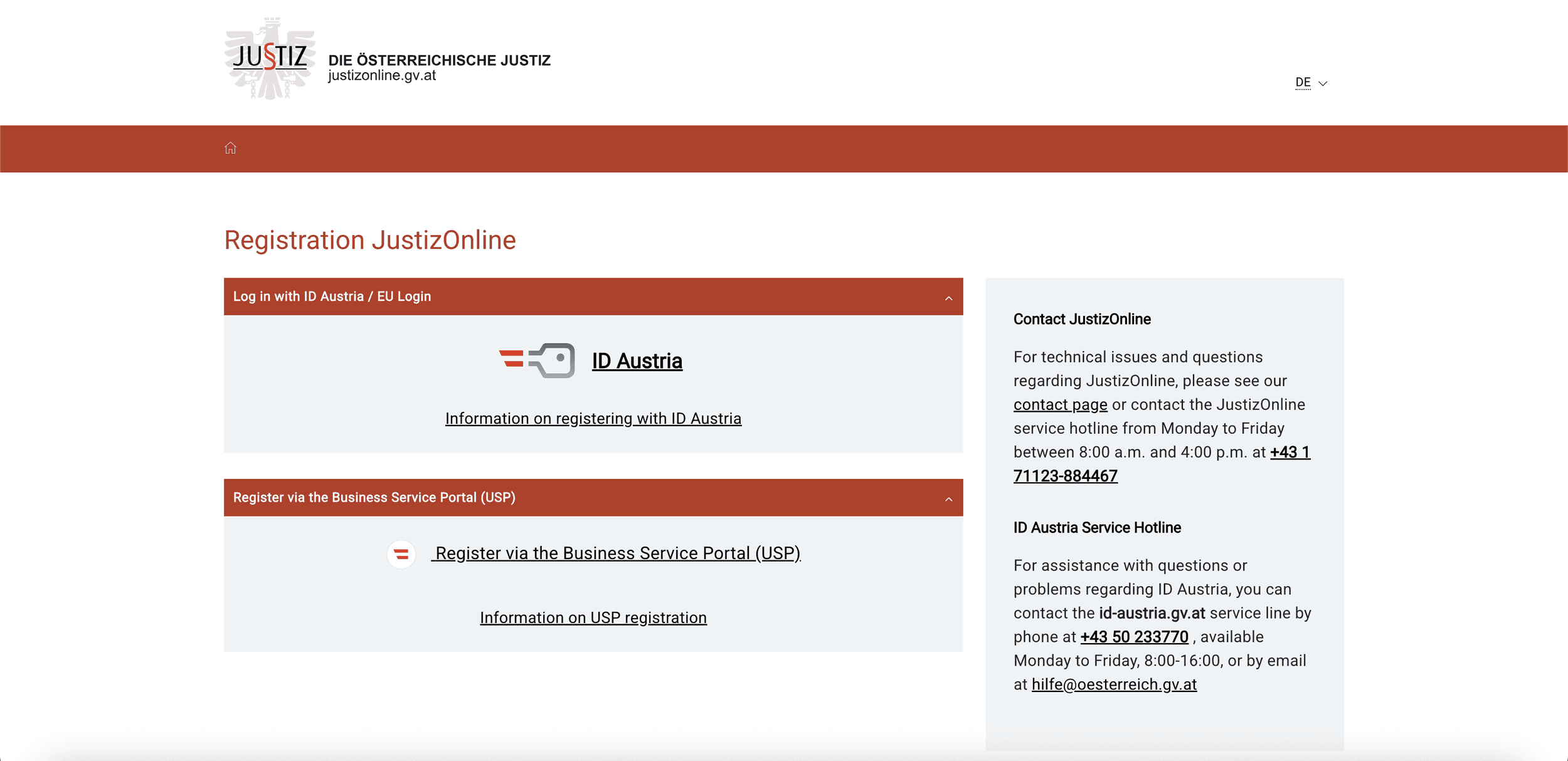
Retrieving company documents and extracts requires an Austrian or EU log-in ID. [/caption]
Don’t have an eID? Kyckr provides live access to the Firmenbuch and 299 other official company registries worldwide, returning structured company data via API or online portal.
Austrian Company Documents
Current Business Register Extract (€4.63): A snapshot of a legal entity at a moment, including shareholders and share capital, director details, registered address, and filing history.
Annual Financial Statement (€10.90): Filed by corporations once a year, providing information on revenue, profit, loans, debts, assets, and the average number of employees yearly.
Articles of Association (€10.90): Details on the legal entity’s structure, internal governing principles, and laws.
APIs and Open Data
Austria provides API access to Firmenbuch data. It is free to use but requires an Austrian ID to register.
The API returns company data, but other APIs are available for data on restructuring officers, mediators, court documents, and debtors with an inability to pay.
This is a meaningful limitation for non-Austrian professionals. Without an Austrian ID, programmatic access is blocked.
Austria’s Beneficial Ownership Register
The Wirtschaftliche Eigäntuemer Registergesetz (WiEReG) is Austria’s central register of beneficial owners (UBOs). Unlike the Firmenbuch, access is not open. It operates on a strict case-by-case basis and costs €4 per entry.
What Information Is Available?
The register holds details on each beneficial owner, including:
Full name.
Date of birth.
Nationality.
Country of residence.
Nature and extent of beneficial interest (shareholding percentage, voting rights).
Who Can Access It (And How To)
Access to the WiEReG is restricted.
On October 1, 2025, Austria amended the Beneficial Owners Register Act, clarifying the rules around ‘legitimate interest’ access. Those who now qualify include obliged entities in third countries, journalists, academics, and parties entering a business relationship with a specific legal entity.
[caption id=”” align=”alignnone” width=”3360”]
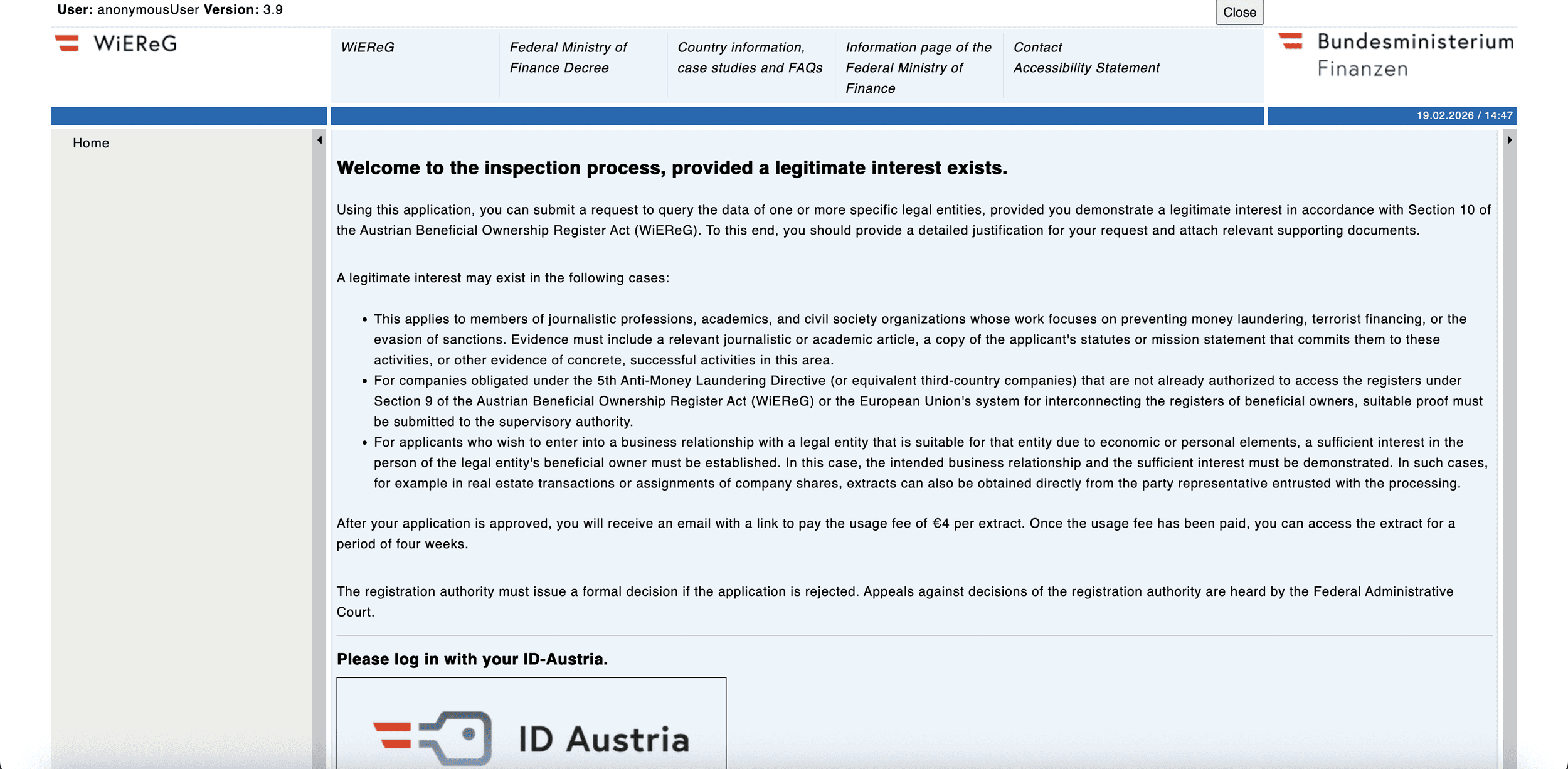
The legitimate interest access process. [/caption]
In practice, however, access remains difficult for non-EU professionals. The sign-up form for legitimate interest access – which the Kyckr Team tested on February 19, 2026 – still requires an Austrian or EU ID, despite the amended rules nominally including third-country obliged entities.
Is Austria’s UBO Register Reliable?
Austria’s Federal Ministry of Finance states that beneficial ownership data is regularly checked and cross-referenced against other government databases. The controls built into the system are more rigorous than those of many EU member states.
Monitoring. Reports are continuously monitored, risk-categorised, and randomly sampled to detect errors.
Data accuracy. Smart filing forms require ID uploads and cross-check submissions against the residents’ register. A bPK identifier links Austrian residents’ records to the residents register, triggering automatic updates when a name changes, a person relocates, or dies.
Automated synchronisation. Beneficial owner data for exempt and top-level entities is continuously synced with the company, associations, and supplementary registers.
These are real controls. But they do not eliminate the structural weaknesses common to all UBO registers.
Complex cross-border ownership chains – common in Austrian holding structures – remain difficult to trace from a single register. And where no natural person meets the ownership threshold, the law permits the listing of a senior manager as UBO: a legal workaround that satisfies the filing requirement while concealing the true controlling party.
Treat the register as a starting point, not a verdict.
Reforms: The Federal Government Programme (2025–2029)
Austria’s coalition government published its Regierungsprogramm 2025–2029 – titled “Jetzt das Richtige tun. Für Österreich” – which includes two changes that will directly affect how the Firmenbuch works for international compliance teams.
English as a business language. The government has committed to allowing English-language documents for registry filings. This would reduce a significant friction point for non-German-speaking firms and international startups registering in Austria.
Free basic access. The programme commits to ensuring that basic information from the online Firmenbuch “remains or becomes accessible free of charge.” For compliance teams running high volumes of company checks, this matters.
Neither reform has been implemented yet. Watch the Firmenbuch portal for changes.
Access Structured Austrian KYB Data Instantly
The Firmenbuch and the WiEReG are essential resources for anyone conducting KYC, KYB, or financial crime investigations in Austria. They are also, in places, slow and access-restricted, particularly for non-EU professionals.
That is where live aggregation services matter. Kyckr connects you to 300+ official company registers worldwide – including Austria’s – delivering registry data directly into your workflows.
Frequently Asked Questions
Is the Austrian Firmenbuch free?
Basic searches are free. A current extract costs €4.63; one with historical data costs €7.80. Documents such as annual financial statements and articles of association cost €10.90 each. Certificates are €1.44.
What is the difference between the Firmenbuch and the WiEReG?
The Firmenbuch is the primary commercial register: it records legal entities, their structure, directors, shareholders, and financials. The WiEReG is dedicated to beneficial ownership, the natural persons who ultimately own or control those entities.
Who can access the Austrian WiEReG?
Austrian authorities and obliged entities have full access. Parties with a legitimate interest – including journalists, academics, and third-country AML professionals under the 2025 reforms – may request access. In practice, registration still requires an Austrian or EU ID.
What documents can I get from the Firmenbuch?
You can access full company extracts, annual financial statements, articles of association, minutes, reports, and sample signatures. Most documents are in German; English-language filing is planned but not yet in force.
Does Austria offer an API for the business register?
Yes, and it is free to use. However, it requires an Austrian ID to register, which puts it out of reach for most non-Austrian compliance professionals without a workaround.
How reliable is beneficial ownership data in Austria?
The WiEReG has stronger built-in verification mechanisms than many EU registers – automated cross-checks, bPK identifiers, and anonymous flagging by obliged parties. That said, structural loopholes remain: the 25% threshold, the senior manager fallback, and complex cross-border ownership chains all limit what the register can reveal. Cross-reference with other sources.