" height="19.593489627012634px" id="HZMnoshln" transform="translate(35.667 1.777)" width="65.54153019346582px"/><path d="M 0 0.017 C 2.315 0.103 4.878 -0.071 7.193 0.036 C 7.468 0.279 12.481 5.793 12.556 5.958 C 11.717 6.005 10.736 5.956 9.888 5.958 C 8.409 5.961 6.923 5.977 5.446 5.957 C 4.793 5.44 4.259 4.69 3.684 4.077 L 1.651 1.879 C 1.049 1.235 0.525 0.741 0 0.017 Z" fill="rgb(0, 190, 110)" height="5.978734113643265px" id="B_ZyWaY8J" transform="translate(12.847 17.922)" width="12.556331656472807px"/><path d="M 18.85 0 L 25.936 0 C 24.823 1.198 23.694 2.514 22.583 3.726 L 11.098 16.3 L 7.002 20.802 C 6.307 21.56 5.61 22.392 4.847 23.07 C 3.802 23.997 1.958 23.832 0.982 22.861 C 0.429 22.31 0.203 21.736 0 20.995 L 0 4.033 C 0.736 4.729 1.513 5.612 2.204 6.369 L 5.127 9.559 C 5.157 10.119 5.127 10.896 5.126 11.475 C 5.128 12.703 5.12 13.932 5.101 15.16 C 5.602 14.614 6.075 14.035 6.574 13.485 L 11.831 7.736 C 14.119 5.193 16.502 2.478 18.85 0 Z M 60.302 6.916 C 61.496 6.907 62.723 6.937 63.927 6.935 C 62.687 10.72 61.245 14.453 59.866 18.186 C 59.324 19.656 58.713 21.843 58.009 23.157 C 57.54 24.036 56.936 24.913 56.037 25.37 C 55.493 25.647 54.887 25.798 54.297 25.935 L 52.098 25.935 C 51.91 25.715 52.001 23.361 51.992 22.874 C 54.16 22.932 54.67 22.721 55.309 20.461 L 52.023 11.377 C 51.506 9.944 50.881 8.391 50.444 6.937 C 51.689 6.941 52.935 6.933 54.181 6.913 C 54.393 7.343 54.775 8.624 54.941 9.14 C 55.392 10.543 55.864 11.949 56.361 13.336 C 56.62 14.057 56.993 15.495 57.285 16.127 C 57.802 14.421 58.424 12.752 58.95 11.029 C 59.213 10.164 59.955 7.668 60.302 6.917 Z" fill="rgb(255, 255, 255)" height="25.9350729038176px" id="RJr52Ozxy" width="63.92682320478577px"/></g></svg>)
Spain’s business registry, Registro Mercantil, is easy to use but offers basic data. Anything else requires a lengthy authentication of your ID.
The Kyckr Team accessed the Spanish business registry on February 25, 2026. In this guide for KYB teams, we explain what information is available, how to access it, and Spain’s beneficial ownership regime.
What Data Is Available?
Free:
Company name.
IRUS (Identificador Registral Único de la Sociedad) – a unique company identifier.
NIF (Número de Identificación Fiscal) – Spain’s standard tax ID for legal entities, equivalent to what was formerly called the CIF.
Status.
Office (region, e.g., Madrid).
Restricted:
Registration date.
Compliance with filing obligations.
Directors and officers.
Beneficial ownership disclosures.
Financial information.
Remember: Shareholder data is extremely limited in Spain.
Which Entities Must Register
The following entities must register:
Limited Liability Company (Sociedad de Responsabilidad Limitada - S.L.): The most common entity for SMEs, requiring a minimum capital of only €1. Must file annual financial statements, shareholder details are recorded at incorporation/transfer via notary, and UBOs must be declared annually and updated within 10 days of any change.
Joint Stock Company (Sociedad Anónima - S.A.): Designed for large-scale enterprises and mandatory for listed companies, requiring a minimum share capital of €60,000 (25% paid upfront). Subject to stricter auditing requirements for financial statements, shareholder details are private, with mandatory annual UBO declarations via the Registry.
Branches of Foreign Companies (Sucursales): Lacks a separate legal personality from the parent company but operates as a permanent establishment with its own tax ID and registered representative in Spain. Must deposit the parent company’s financial statements (translated/apostilled) and register its own UBO information with the Spanish Registry.
General and Limited Partnerships (Sociedad Colectiva / Comanditaria): Based on personal trust between partners, where at least one partner (the general partner) has unlimited personal liability for the entity’s debts. Required to register the partnership deed and file annual accounts. UBO reporting is mandatory for any natural person holding >25% control.
How to Search for Spanish Companies
1. Go to the Website.
The Registrars of Spain handle multiple registries, including the business, personal property and land registries.
On the homepage, scroll down to ‘Business Registry’ and click “Request business registry note of information”.
Tip: Select the English translation from the top-right bar. The Kyckr Team still encountered problems with translations, with some pages only being partially translated on February 25, 2026.
[caption id=”” align=”alignnone” width=”3360”]
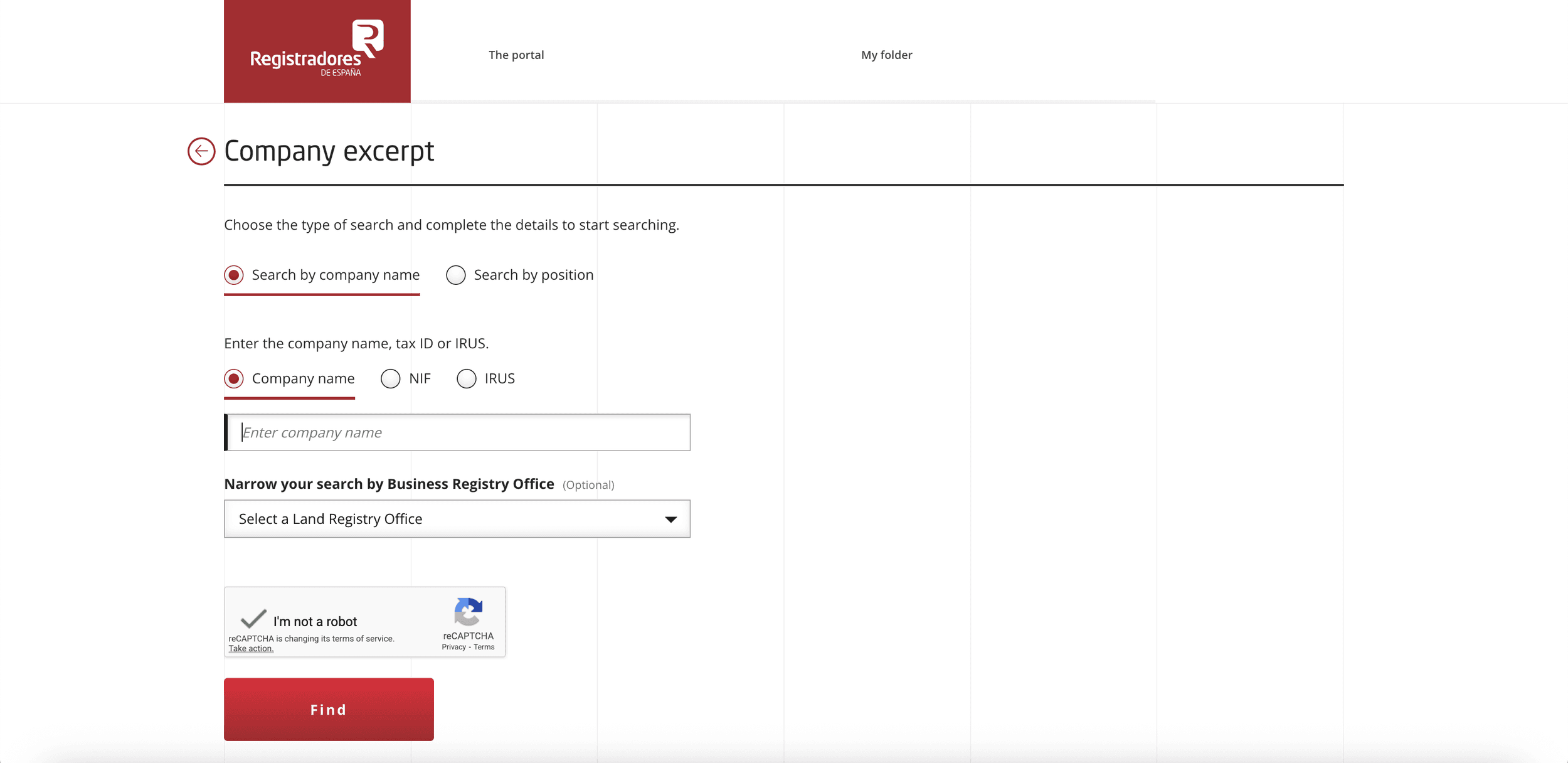
Spain’s business registry portal. [/caption]
2. Search a Company.
You can search by company name or ‘position’ (officers or owners), which requires access via a digital certificate.
Search by: Company name, tax ID (NIF), or IRUS.
Refine by: Region.
Click ‘I am not a robot’ and proceed.
3. View Results.
The search portal only displays 100 out of potentially thousands of results. Tip: refine by region.
The data displayed is thus:
Company name.
IRUS.
NIF.
Status.
Office (region, e.g., Madrid).
Useful to know: A red question mark hovers near entry names that are historic, showing changed names.
4. Select a Company.
The data displayed is basic. For a more detailed overview, you must purchase a company excerpt, certificate, or accounting records.
5. Buy a Company Excerpt.
Click ‘Company Excerpt’.
Select what info you want: basic info, social capital, legal representatives and directors, registration information, and annual account records.
Click ‘Continue’. A fully detailed excerpt costs €6.58.
Identify yourself. Either use a digital certificate or fill out details, including company name, passport number, and phone number.
With Kyckr, you don’t have to do any of that.
[caption id=”” align=”alignnone” width=”3360”]
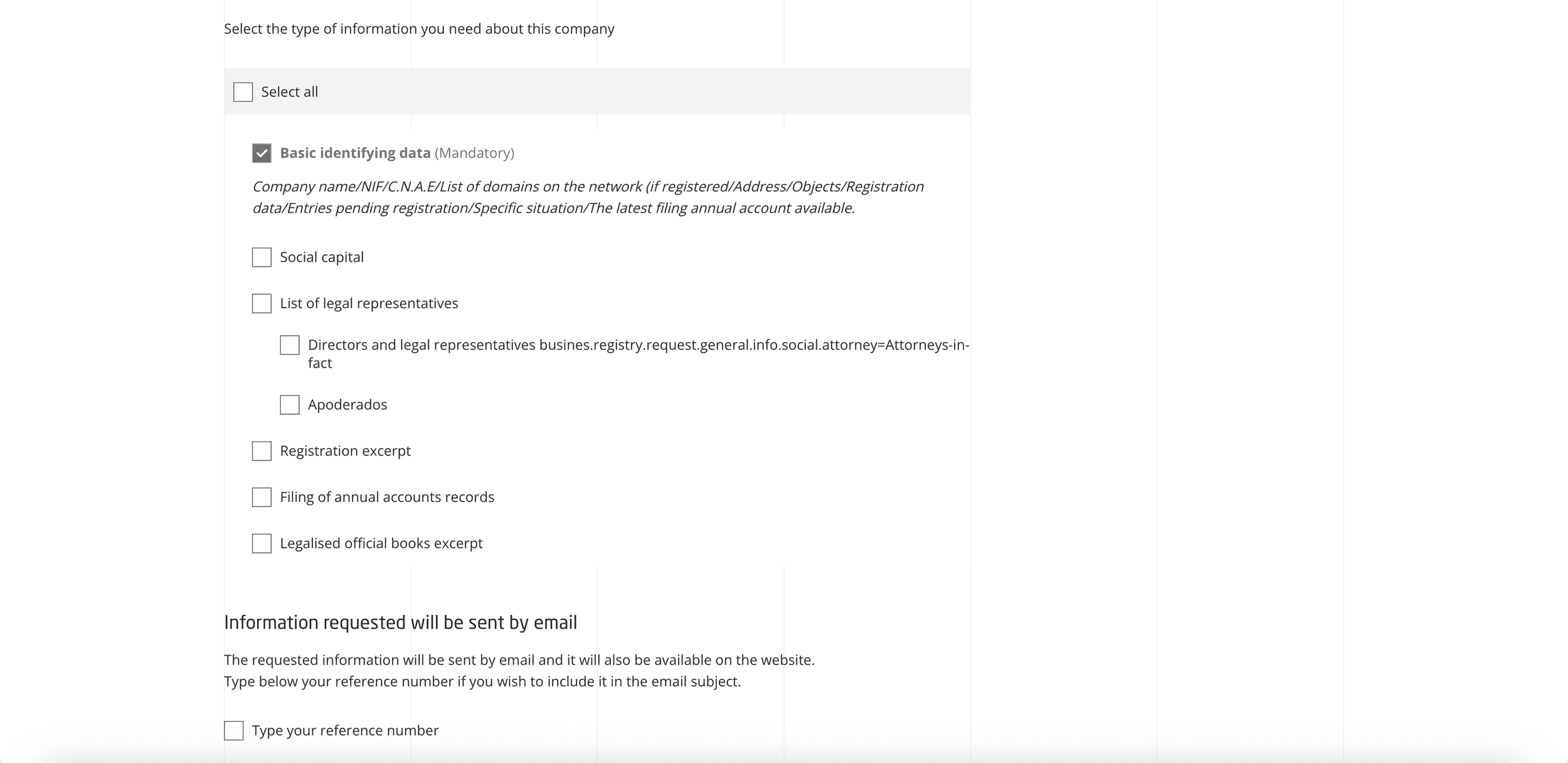
Filling out a company excerpt request. [/caption]
Available Documents
The following documents are available to buy and download from Spain’s business registry:
Certificate of Incumbency: Confirms that a named person currently holds a specific role in the company’s governing body.
Certificate of Good Standing: Confirms that the company exists and lists every person currently serving on its governing body.
Certificate for the Issuance of a Legal Entity Representative: Confirms that a named person currently holds a role in the company’s governing body or has been authorised to obtain the company’s electronic signature certificate on its behalf.
Certificate of Power of Attorney in Fact: Confirms that a named person has been granted powers to act on behalf of the company, and states what those powers are.
Certificate of Articles of Association: Contains the full, exact text of the company’s Articles of Association as currently registered.
Certificate of Beneficial Ownership: Names the people who ultimately own or control the company. For each person, it states their name, ID number, date of birth, nationality, country of residence, and ownership percentage where relevant.
Filing of Annual Accounts: Contains the company’s financial records for a chosen fiscal year: the balance sheet, profit and loss account, notes to the accounts, changes in net equity, and cash flows. An auditor’s report and management report are included where the law requires them.
API and Open Data
There is no true open REST API for querying individual Spanish company records in real time.
What exists is an Open Data portal at opendata.registradores.org providing access to company data as provided for under Article 17.5 of the Commercial Code in Law 11/2023.
This is described as “an initial approach that will be completed gradually.” This portal offers downloadable statistical datasets and microdata, not programmatic per-company queries.
Alternatively, Kyckr provides access to the Spanish business registry, retrieving structured company data in real time.
What Data Is Available?
The datasets on the Open Data portal are more detailed than those of the Business Registry. They include the following:
Company name.
Company form.
Company ID number (NIF, IRUS and EUID).
Activity codes (CNAE and NACE).
Website.
Company directors and officers.
Registered office.
Remember: If you want to buy documents or certified excerpts, you must go back to the main portal of the Business Registry to buy and download documents.
Beneficial Ownership Information
Spain’s beneficial ownership registry, the Registro Central de Titularidades Reales, technically discloses UBO information to those with legitimate interest. As of February 25, 2026, when the Kyckr Team accessed the registry, we found it virtually impossible.
Applicants must log in with a Spanish ID.
All email exchanges must be in Spanish.
Example: It took Transparency International’s Spanish subsidiary 6 months to be granted access. Even then, UBO details excluded the nature of the beneficial ownership.
What About Shareholder Information?
The initial shareholders are public record because they are listed in the original incorporation deed (escritura de constitución), which is filed with the Commercial Registry.
However, in a Spanish S.L., subsequent transfers of shares (after the initial incorporation) are formalised through a notarial deed, but these changes are not required to be registered in the Commercial Registry.
Spanish Due Diligence, Made Simple
The Spanish business registry is challenging to use for enhanced due diligence. Much of its data is behind a paywall and authentication systems, making it difficult for anyone who isn’t a Spanish citizen.
Kyckr removes this hurdle. Our portal and API return Spanish data instantly and enable the retrieval of company documents in real time – all without logging in and providing your identity every time.