" height="19.593489627012634px" id="HZMnoshln" transform="translate(35.667 1.777)" width="65.54152709402429px"/><path d="M 0 0.017 C 2.315 0.103 4.878 -0.071 7.193 0.036 C 7.468 0.279 12.481 5.793 12.556 5.958 C 11.717 6.005 10.736 5.956 9.888 5.958 C 8.409 5.961 6.923 5.977 5.446 5.957 C 4.793 5.44 4.259 4.69 3.684 4.077 L 1.651 1.879 C 1.049 1.235 0.525 0.741 0 0.017 Z" fill="rgb(12, 241, 145)" height="5.978734113643265px" id="B_ZyWaY8J" transform="translate(12.847 17.922)" width="12.556331656472807px"/><path d="M 18.85 0 L 25.936 0 C 24.823 1.198 23.694 2.514 22.583 3.726 L 11.098 16.3 L 7.002 20.802 C 6.307 21.56 5.61 22.392 4.847 23.07 C 3.802 23.997 1.958 23.832 0.982 22.861 C 0.429 22.31 0.203 21.736 0 20.995 L 0 4.033 C 0.736 4.729 1.513 5.612 2.204 6.369 L 5.127 9.559 C 5.157 10.119 5.127 10.896 5.126 11.475 C 5.128 12.703 5.12 13.932 5.101 15.16 C 5.602 14.614 6.075 14.035 6.574 13.485 L 11.831 7.736 C 14.119 5.193 16.502 2.478 18.85 0 Z M 60.302 6.916 C 61.496 6.907 62.723 6.937 63.927 6.935 C 62.687 10.72 61.245 14.453 59.866 18.186 C 59.324 19.656 58.713 21.843 58.009 23.157 C 57.54 24.036 56.936 24.913 56.037 25.37 C 55.493 25.647 54.887 25.798 54.297 25.935 L 52.098 25.935 C 51.91 25.715 52.001 23.361 51.992 22.874 C 54.16 22.932 54.67 22.721 55.309 20.461 L 52.023 11.377 C 51.506 9.944 50.881 8.391 50.444 6.937 C 51.689 6.941 52.935 6.933 54.181 6.913 C 54.393 7.343 54.775 8.624 54.941 9.14 C 55.392 10.543 55.864 11.949 56.361 13.336 C 56.62 14.057 56.993 15.495 57.285 16.127 C 57.802 14.421 58.424 12.752 58.95 11.029 C 59.213 10.164 59.955 7.668 60.302 6.917 Z" fill="rgb(255, 255, 255)" height="25.9350729038176px" id="RJr52Ozxy" width="63.92682320478577px"/></g></svg>)
Blog
What Is A KYC Database? Everything Compliance Teams Need to Know in 2026
Author
The Kyckr Team
Published
Most compliance teams use a KYC database every day. Few have tested whether the data inside it is any good.
This article explains what KYC databases are, how they work, where their data comes from, and why the gap between what vendors promise and what registries hold can cost a firm its reputation and its licence.
What Is a KYC Database?
A KYC database is a structured repository of identity, ownership, and risk data on individuals and companies, used by compliance teams to verify customers and screen for financial crime risk during onboarding and ongoing monitoring.
Most databases fall into two categories: one for companies and one for individuals. Moody's, Dun & Bradstreet, and Open Corporates are common examples of a company database.
What Does a KYC Database Typically Contain?
Most cover four areas:
Company registration details (name, address, legal status, registration number).
Ownership and control (who owns the company and who runs it).
Sanctions and watchlists (people and entities that governments have barred from doing business).
Politically exposed persons, known as PEPs – officials, judges, and others whose position makes them a higher money laundering risk.
Some databases also flag adverse media: press coverage linking a person or company to fraud, corruption, or crime.
Why Compliance Teams Use Them
Speed is the main draw. KYC databases offer API access, so analysts can pull company data in seconds rather than hours. That cuts onboarding time and reduces the number of customers who give up before finishing the process.
Until recently, databases were simply faster than accessing official registries directly. The old method – logging into a registry portal, downloading filings, reading documents, and typing the results into a spreadsheet – took hours per company. Databases turned that into seconds.
How Things Stand Now
In 2026, most regulated firms use both KYC databases and official registries. Databases work well for quick searches – especially when you don't know which country a company is registered in, or for firmographic data. Official registries remain the better choice for enhanced due diligence on high-risk customers, for accessing original filings, and for checking whether database records are still current.
How a KYC Database Actually Works
People often think of a KYC database as a giant filing cabinet. It is really a data-cleaning machine. Official registries publish company information in formats that computers cannot read easily – blurry PDFs, scanned images, inconsistent text. A KYC data provider scrapes this raw material and converts it into a clean, structured format (usually JSON or XML) that a bank's AML or risk-scoring system can process automatically.
Where the Data Comes From
The best KYC database vendors tell you exactly where they get their data. Most do not go directly to official registries. Here is what some of the major providers say about themselves:
Open Corporates: Official registries only.
Dun & Bradstreet: A mix of official sources, private companies, credit agencies, local press, partner firms, and other data vendors.
Moody's Orbis: Official sources plus more than 170 third-party vendors, company websites, and financial regulators.
Sayari: A mix of official government databases and supply chain participants, such as freight forwarders and global feeders.
Global Database: A mix of official sources, including government agencies, web crawlers and partnerships with other commercial data vendors.
Remember: Just because data comes from a secondary or tertiary source doesn’t mean it isn’t valuable. KYC databases have useful applications across tasks such as mapping illicit networks, auto-filling registration forms, and credit checks. But for KYB, live company registry data ensures freshness.
How Old Is the Data?
KYC databases, by their very nature, store data; they do not pull it live from a primary source. Providers often download bulk datasets from registries on a schedule, which means what you see may already be out of date. How far out of date depends on the provider and the country:
OpenCorporates: Refresh times vary considerably, which they are very transparent about. Some areas are particularly strong, such as the UK, Denmark, and the US, but some jurisdictions have more irregular refreshes or purely archive records.
Dun & Bradstreet: It varies. Some sources update daily; others once a year.
Moody's Orbis: Sanctions lists refresh every 24 hours; ownership and beneficial owner data updates weekly.
Sayari: Varies by country. Public records indicate trade data is updated monthly, sometimes quarterly.
Global Database: Varies. Sometimes daily, other times “on demand”.
Always check the last refresh date when retrieving a record; uneven sourcing and infrequent updates mean the data you rely on may be wrong before you even view it.
Why Stale Data Can Be Problematic
FATF guidance is clear: firms must verify customers using "reliable, independent source documents, data or information." When data has been routed through multiple third parties, it can sometimes be difficult to know its authenticity or liveness.
Regulators are acting on this. Kyckr's report, The Data Blind Spot, found that low-quality data contributed to 68% of UK anti-money laundering (AML) fines issued by the Financial Conduct Authority between 2020 and 2025. Three cases illustrate what goes wrong:
ADM Investor Services International: Ran its PEP checks against an outdated list.
Gatehouse Bank: Screened the shareholders of a Special Purpose Vehicle against an old investor list. It took two years to discover the current investors were PEPs.
Ghana International Bank: Failed to spot dormant accounts, missing the official record showing the entity had stopped trading five years earlier.
The FCA's Final Notice on Gatehouse Bank put it plainly: outdated records meant the firm "failed to properly assess the money laundering risk" of its customers.
Five Questions to Ask Before Choosing a KYC Database
1. Where does the data come from?
Does the vendor pull data directly from official registries, or does it aggregate from third-party vendors and partner networks? Each extra link in the chain is another chance for data to go stale or be wrong.
2. How fresh is the data?
Update frequency varies by country, not just by vendor. A database might refresh UK data daily and South American data once a year. Do not accept vague promises like "regularly updated" or "near real-time." Ask specifically about the jurisdictions where your riskiest customers are based.
3. How deep is the coverage?
The number of records matters less than what those records contain. Does the database give you Ultimate Beneficial Owner data for the countries you need, or just registration numbers? Can it retrieve original filings, or only pre-processed data fields? For enhanced due diligence on high-risk entities, the gap between these two is significant.
4. Does it fit your existing workflow?
A database your team cannot access easily is no use at all. Look for clean API documentation and data delivered in a structured format, especially if you run automated onboarding.
5. Is the vendor open about its sources?
If a vendor cannot tell you where their data originates, that is your answer. Ask for a data lineage document. Ask for a sample output showing timestamps and source attribution. Timestamped, attributed data is the difference between a clean audit and an expensive one. If they cannot provide these, look elsewhere.
KYC Database vs Live Registry Connections
[caption id="" align="alignnone" width="1806"]
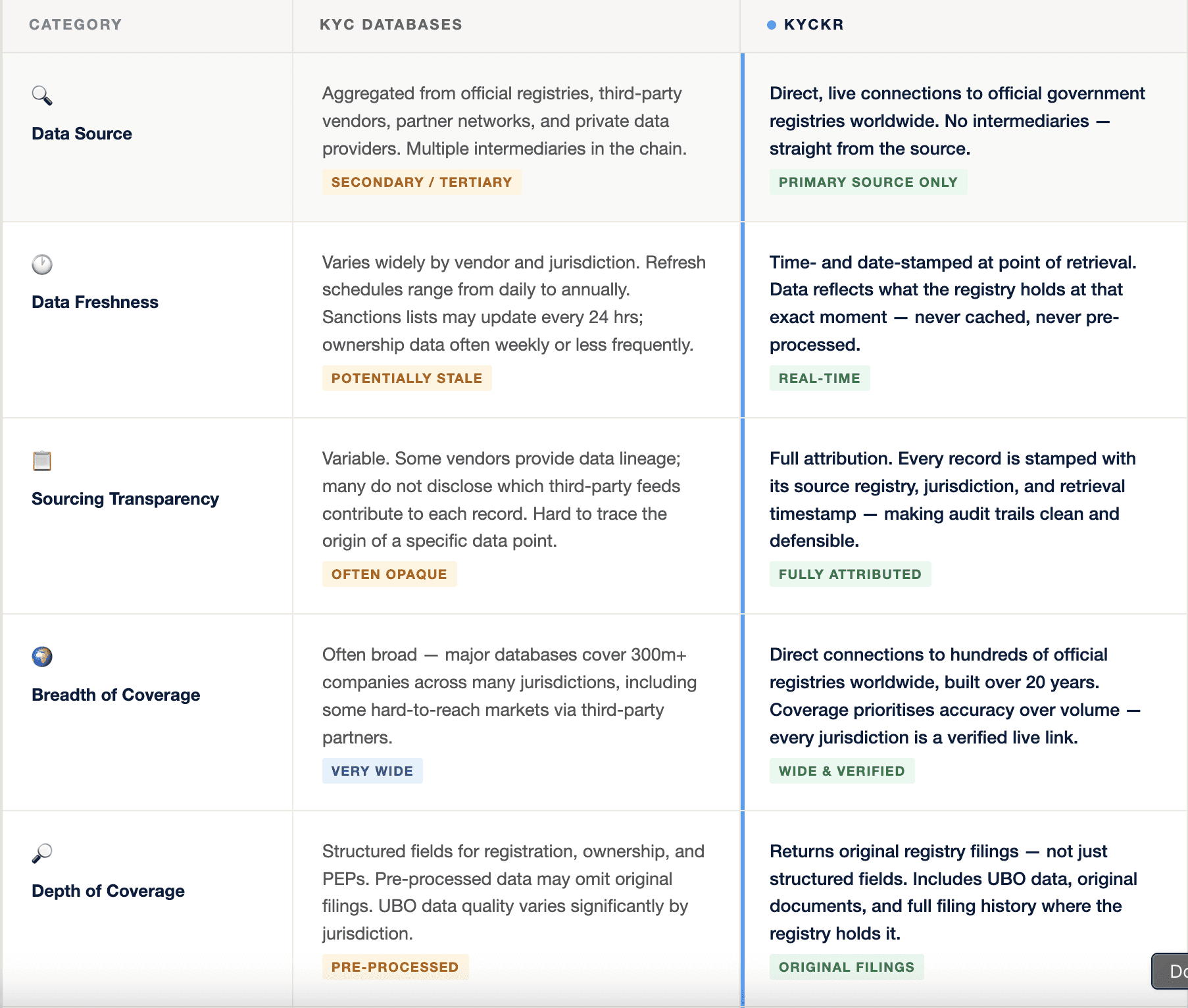
KYC Database vs Kyckr [/caption]
Why Kyckr Is Not A KYC Database
Kyckr is not a database. It is a live connection to official company registries. Over the past 20 years, Kyckr has built direct links to hundreds of registries worldwide, so the data it returns – time and date-stamped – is what the registry holds at that exact moment. Not two weeks old. Not five years old. Not filtered through third-party vendors. Straight from government sources.
Regulators want to know that compliance teams made the right call on the best information available. Kyckr makes that case easy to make.
Frequently Asked Questions
What is a KYC database?
A KYC database holds identity and risk data on people and companies. Banks and financial firms use it to check who they are dealing with before – and after – they take them on as customers. The data typically covers names and addresses, company ownership, sanctions listings, and records of people in public life who carry a higher financial crime risk.
What is the difference between a KYC database and an official registry?
An official registry is the source. A government body maintains it and updates it when something changes – a new director, a dissolved company, a changed address. A KYC database copies from that source on a schedule. By the time you query it, the data may be days, months, or years old. The registry holds the truth. The database holds a copy of the truth as it stood when someone last looked.