" height="19.593489627012634px" id="HZMnoshln" transform="translate(35.667 1.777)" width="65.54152709402429px"/><path d="M 0 0.017 C 2.315 0.103 4.878 -0.071 7.193 0.036 C 7.468 0.279 12.481 5.793 12.556 5.958 C 11.717 6.005 10.736 5.956 9.888 5.958 C 8.409 5.961 6.923 5.977 5.446 5.957 C 4.793 5.44 4.259 4.69 3.684 4.077 L 1.651 1.879 C 1.049 1.235 0.525 0.741 0 0.017 Z" fill="rgb(12, 241, 145)" height="5.978734113643265px" id="B_ZyWaY8J" transform="translate(12.847 17.922)" width="12.556331656472807px"/><path d="M 18.85 0 L 25.936 0 C 24.823 1.198 23.694 2.514 22.583 3.726 L 11.098 16.3 L 7.002 20.802 C 6.307 21.56 5.61 22.392 4.847 23.07 C 3.802 23.997 1.958 23.832 0.982 22.861 C 0.429 22.31 0.203 21.736 0 20.995 L 0 4.033 C 0.736 4.729 1.513 5.612 2.204 6.369 L 5.127 9.559 C 5.157 10.119 5.127 10.896 5.126 11.475 C 5.128 12.703 5.12 13.932 5.101 15.16 C 5.602 14.614 6.075 14.035 6.574 13.485 L 11.831 7.736 C 14.119 5.193 16.502 2.478 18.85 0 Z M 60.302 6.916 C 61.496 6.907 62.723 6.937 63.927 6.935 C 62.687 10.72 61.245 14.453 59.866 18.186 C 59.324 19.656 58.713 21.843 58.009 23.157 C 57.54 24.036 56.936 24.913 56.037 25.37 C 55.493 25.647 54.887 25.798 54.297 25.935 L 52.098 25.935 C 51.91 25.715 52.001 23.361 51.992 22.874 C 54.16 22.932 54.67 22.721 55.309 20.461 L 52.023 11.377 C 51.506 9.944 50.881 8.391 50.444 6.937 C 51.689 6.941 52.935 6.933 54.181 6.913 C 54.393 7.343 54.775 8.624 54.941 9.14 C 55.392 10.543 55.864 11.949 56.361 13.336 C 56.62 14.057 56.993 15.495 57.285 16.127 C 57.802 14.421 58.424 12.752 58.95 11.029 C 59.213 10.164 59.955 7.668 60.302 6.917 Z" fill="rgb(255, 255, 255)" height="25.9350729038176px" id="RJr52Ozxy" width="63.92682320478577px"/></g></svg>)
Australian obliged entities face an awkward problem: the law requires them to verify the ultimate beneficial owner of corporate customers, but Australia has no UBO register. So how do you do it?
This guide explains.
What Is a Beneficial Owner in Australia?
A beneficial owner is a natural person who controls or owns an entity, directly or indirectly, through:
Ownership: a 25% or greater stake in the entity.
Control: ultimate control of the entity, regardless of formal ownership.
Benefit: deriving benefit from the entity, even without owning it.
Australia’s definition closely follows the Financial Action Task Force’s.
Does Australia Have a UBO Register?
No, but it plans to build one. On 27 August 2025, ASIC announced $207 million in additional funding over two years, part of which will go towards a beneficial ownership register. Public consultation is expected to begin in early 2027.
Until then, you’re on your own.
How To Verify Australian UBOs
Without a register, you must reconstruct ownership from company filings at ASIC. Here’s how.
Step 1: Search ASIC Connect
Searching is free. Find the entity and click through to its record.
Step 2: Buy the right document
Three filings are useful:
Current Company Extract ($10 online, $13 by post): names, addresses, shareholdings, and financial reports.
Current and Historical Company Information ($20 online, $23 by post): share structure, shareholder history.
Roles and Relationship Extract ($23 online, $26 by post): registration details and any relational roles the company holds in other entities.
Step 3: Check for nominees
Using nominee shareholders is legal in Australia. Unlike in Singapore, there’s no flag on the filing to indicate that a nominee is being used. If you see the same shareholder appearing across multiple unrelated businesses, it’s likely a corporate service provider acting as a nominee.
Step 4: Follow the chain overseas
A significant minority of Australian entities have shareholders registered abroad. If that’s the case, go to the relevant overseas registry and repeat the process.
Step 5: Repeat until the trail ends
Keep following the chain through each jurisdiction until you reach a natural person, or until the registry stops publishing data. If a registry doesn’t collect or publish shareholder information, apply enhanced due diligence.
Trust structures present a specific challenge: Trust deeds and beneficiary registers aren’t held in company registries anywhere. If your customer is a trust or has a trust in the ownership chain, registry data will stop at the trustee entity. From that point, documentation from the customer is the only path.
Why This Is Harder Than It Sounds
It’s entirely manual. ASIC’s API is SOAP-based and doesn’t expose shareholder data in a form that feeds cleanly into KYB workflows. Every search, every purchase, every extraction is done by hand.
Nominees are invisible. In France and Estonia, nominee use is restricted. In Singapore, it’s disclosed. In Australia, it’s legal and opaque.
The ownership chain is often global. Many Australian entities are owned, at least in part, by overseas companies. According to the Australian Tax Office (ATO), a large share of Australian beneficial owners is incorporated abroad, including in jurisdictions that publish nothing useful for UBO verification.
Where Australian UBOs sit (and where ownership discovery works)
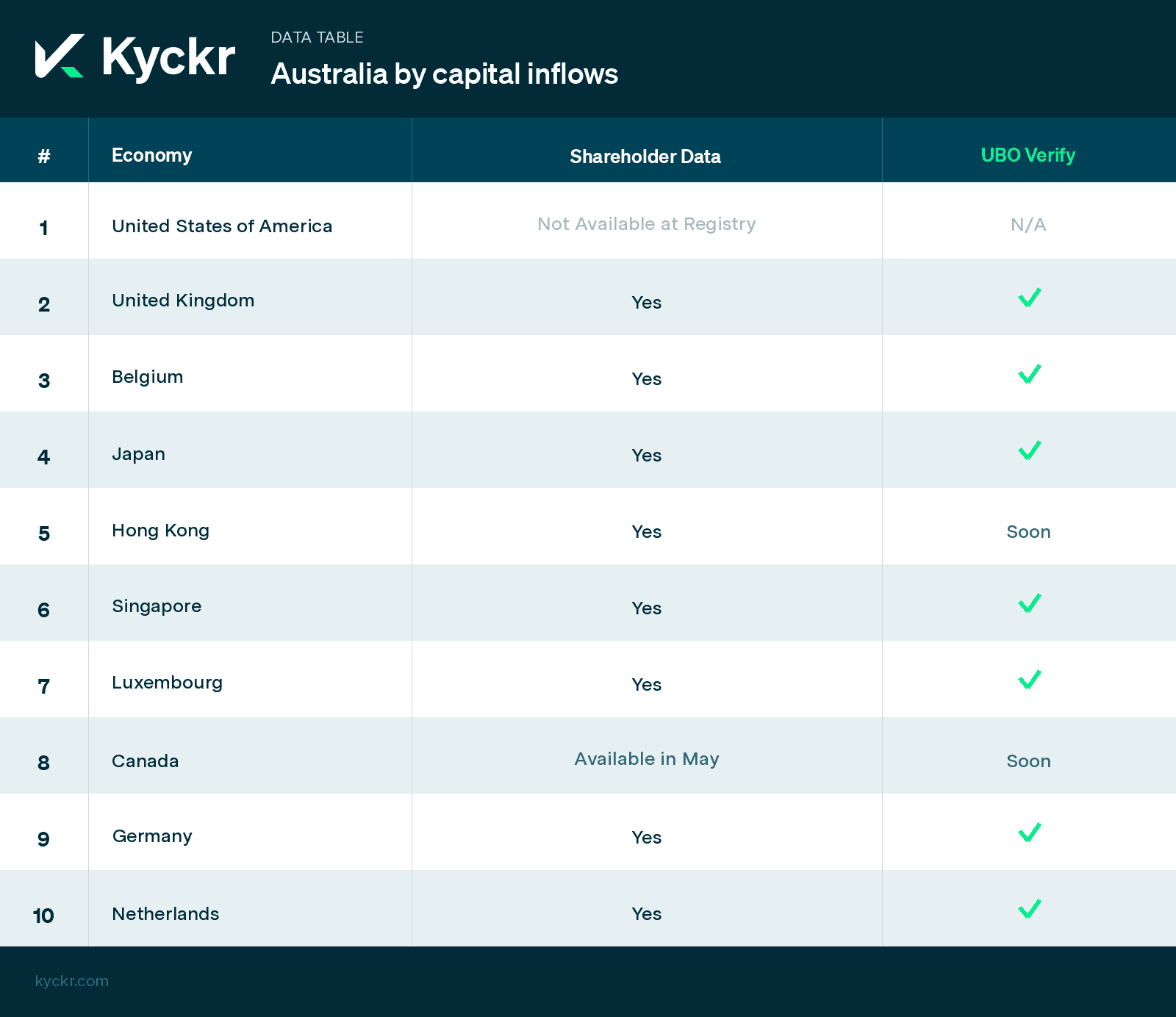
Ownership discovery works in nearly all foreign jurisdictions involved in Australia.
According to the Department of Foreign Affairs and Trade, most countries that invest in Australia publish shareholder information, which means that UBO verification for overseas beneficial owners, using Kyckr’s ownership discovery, is straightforward.
UK: Shareholder data and Persons of Significant Control are both publicly accessible.
Belgium: Shareholder data and UBO disclosures are available.
Japan: Ownership data is available, but the search interface requires Japanese characters.
Hong Kong: Publishes shareholder data, but not beneficial ownership.
Singapore: Shareholder information is published in company filings.
Luxembourg: Shareholder data is available.
Canada: One-third of provinces collect shareholder data, and the federal register includes UBO information.
Germany: Shareholder data is available.
Netherlands: Only the main shareholder appears, and the data isn’t available in machine-readable form.
There’s only one exception: The US. Since March 2025, domestic UBO data has no longer been collected federally. Only one state publishes shareholder information.
What If the Overseas Registry Doesn’t Publish Shareholder Data?
Australia’s new AML/CTF reforms came into force on 31 March 2026. Here’s what the guidance says.
What AUSTRAC requires
When a customer has a connection to a high-risk jurisdiction, you must apply enhanced customer due diligence, which includes checking where the customer’s wealth comes from and where the specific funds for the transaction come from.
ECDD is also triggered by complex ownership structures or suspicious behaviours, and under the new 2025 rules, it must be applied where services have no apparent economic or legal purpose or involve unusually complex or large transactions.
In plain terms: an ownership chain that disappears into the Cayman Islands or Bermuda is itself a risk signal, and AUSTRAC expects you to respond to it as one.
What enhanced due diligence looks like in practice
When registry data runs out, you have several options:
Request documentation directly from the customer. Ask them to provide a shareholder register, corporate structure chart, or certified extract from their home registry. This is slower and depends on the customer’s cooperation, but it’s legitimate.
Source of wealth and source of funds checks. Where is the money coming from, and how was the wealth built? These are required under ECDD regardless of whether you can verify ownership through a registry.
Senior management sign-off. Enhanced CDD measures include obtaining senior management approval for high-risk customers. If you can’t verify the ownership chain, the decision to proceed (or not) should sit with someone senior and be documented.
Consider declining the relationship. AUSTRAC’s framework is risk-based. If the ownership structure is genuinely opaque and the customer can’t or won’t clarify it, refusing to onboard is a legitimate outcome, and sometimes the right one.
A Faster Way
Kyckr connects directly to 300+ company registries worldwide, pulling structured shareholder data wherever it’s publicly available, including all major capital inflow markets: the UK, Canada, Singapore, China, and the Eurozone. This means, in most cases, UBO verification is instant.
For Australian obliged entities, that means following the ownership chain from ASIC to wherever it leads, without the manual work.
Book a demo to find out more.
Frequently Asked Questions
Does Kyckr tell you which data it can provide?
Kyckr is transparent about what data it can legally – and actually – provide. Our advice: be cautious if a KYB data provider claims it can access ownership data from secrecy jurisdictions – and be very rigorous about how it sourced that data.